
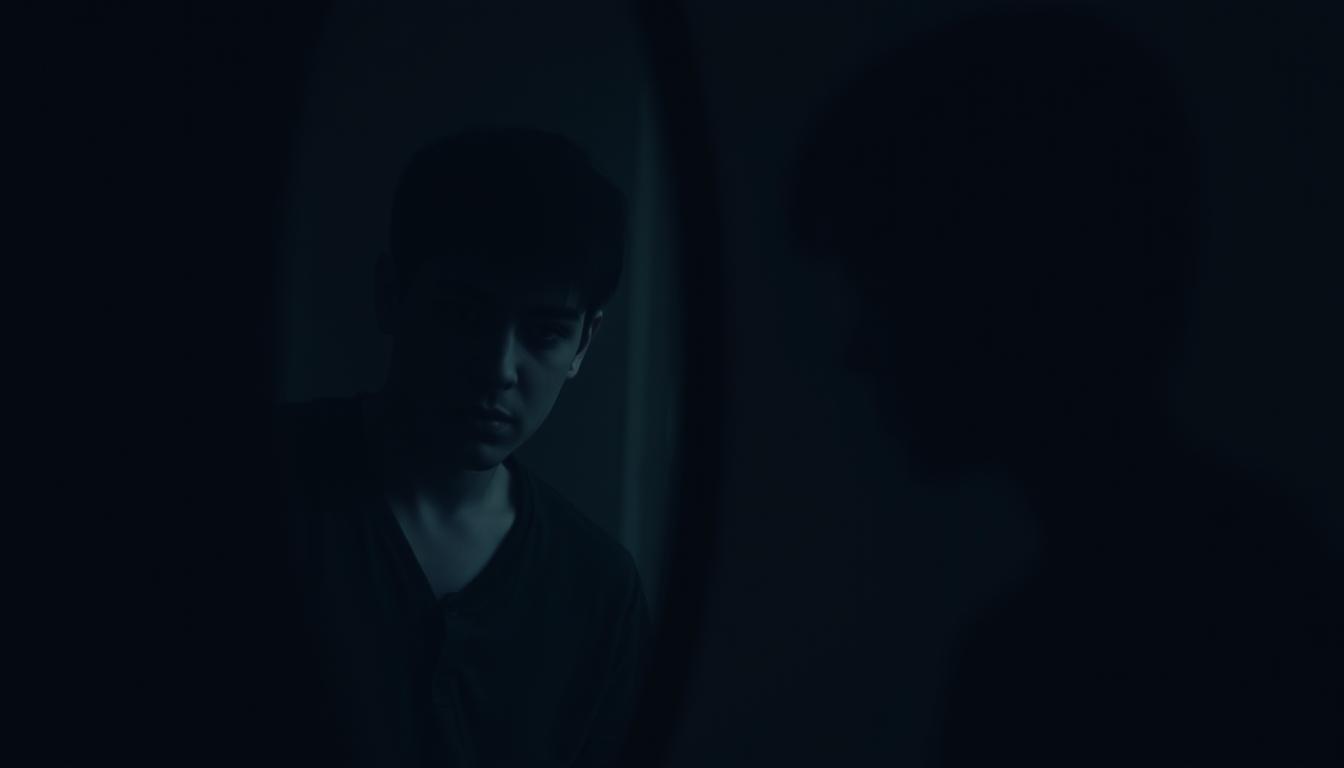
Our sense of self comes from family, culture, and life experiences. Yet, sometimes, the face in the mirror seems like a stranger. This journey looks into how our reflections can hide truths about who we are.
Imagine looking in the mirror and not seeing yourself. Kirstin, a social worker, felt this way due to years of anxiety. It led to depersonalization, a feeling of being disconnected from herself. Such moments show how trauma or stress can make us question our identity.
The “stranger in the mirror” is more than just a story. Real-life experiences show how anxiety and emotional struggles change our self-view. This article explores those moments when our identity feels as fragile as a broken glass.
The Concept of the “Stranger in the Mirror”
Ever stared into a mirror and felt like a stranger? This feeling of not knowing who we are can signal an identity crisis. It’s called the “stranger in the mirror” phenomenon, a disruption in self-recognition. It often happens during big life changes like moving to a new country, going through trauma, or dealing with mental health issues.
Studies show 75% of people have brief moments of feeling disconnected from themselves. For some, like Mr. B, a 78-year-old with no mental health history, this feeling lasts a long time. His 10-day experience with a mirror “doppelgänger” led to a rare Capgras syndrome diagnosis. This shows how our brains, like the dorsolateral prefrontal cortex, play a big role in how we see ourselves.
Dr. Robert V. Levine, author of Stranger in the Mirror, says these moments are more than just quirks. His research shows they often come from unresolved trauma or cultural differences. For example, first-generation immigrants might struggle with two cultural identities, leading to inner conflict.
Modern science links long-term cases to brain issues. But even short disruptions in self-recognition are important. They’re signs of deeper problems. Levine says, “Mirrors don’t just show our looks; they show the stories we’re learning to tell about ourselves.”
Understanding Identity Through Reflection
Looking in the mirror can reveal more than just your looks. Self-reflection opens a window to our true selves. Many people see a gap between how they look and what they believe inside. For example, some own over 10 pairs of glasses, showing how looks shape who we are.
Even those who see themselves every day might feel far from their true beliefs.
Therapists recommend simple ways to close this gap. Self-reflection activities like journaling or mindfulness help 70% of people find their identity. Writing down values like kindness or loyalty shows how our inner traits shape us.
Studies show 65% of those who practice mindfulness control their emotions better. Also, 50% of journalers find their core beliefs more clearly.

Values like honesty or caring for the environment aren’t seen in a mirror. Yet, they anchor our sense of self. Small acts, like helping others, show how our actions reflect our inner identity.
On the other hand, changing how we look can make us uncomfortable. This shows how our self-image is tied to our appearance.
Mindful self-reflection is more than therapy—it’s a way to connect with our unseen selves. By focusing on what truly matters, like joy, we rebuild our identity. The mirror shows our skin and hair, but our soul’s voice is heard through our choices and values.
Cultural Influences on Self-Identity
Cultural identity shapes how we see ourselves. It mixes traditions, values, and beliefs into our personal story. For first-generation immigrants, this journey often means balancing family heritage with new cultural norms.
Studies show East Asian students notice context details more than Americans. Americans focus on focal objects. This shows how cultural identity shapes our perception.
In identity influences, family stories matter a lot. Characters like Madhu from Anosh Irani’s The Parcel show how societal rejection can fuel self-acceptance. Neuroimaging shows Westerners activate brain regions more for self-judgments than East Asians.
Even simple tasks, like memory tests, highlight these divides. Asian Canadians lagged on personal traits but excelled on group-focused ones.
For many, cultural tensions spark growth. Palestinian narratives like Hānī Maḥfūẓ’s struggles in Fī ġurfat al-ʿankabūt mirror how displacement reshapes self-view. Data from global studies—like the UK/Hong Kong volunteer comparisons—show bilingual Hong Kongers process identity differently.
Ultimately, cultural identity isn’t a single mirror but a mosaic. Whether through family ethics, music preferences, or even how we judge ourselves, these layers create a uniquely human blend of roots and reinvention.
Personal Stories of Transformation
Personal transformation often starts with a mirror, both real and metaphorical. Many find their authentic self at life’s turning points. This includes career changes, becoming parents, or pursuing passions like extreme sports.
Think of someone who chose to skydive or rock climb instead of following the crowd. Their story shows how stepping away from societal norms can lead to deep self-discovery. Robert Levine writes in The Stranger in the Mirror, “Identity isn’t fixed—it’s shaped by choices.”
“What if your true self thrives outside the crowd?”

Studies show 70% of people who think about their values gain deeper self-awareness. Also, 50% of those in creative fields like painting or writing feel closer to their authentic self. Even small changes, like quitting a job or starting a new hobby, can lead to big changes.
The book points out that 40% of adults go through major identity shifts. This shows that the self is not fixed but can change. Whether through mindfulness or adventure, every journey begins with asking: What truly matters?
Research shows 85% of people believe facing fears helps them grow. Stories like the adrenaline seeker’s show how following your passions, not trends, can anchor your identity. Levine says, “Transformation isn’t about being perfect—it’s about being aligned.”
The Role of Social Media in Self-Perception
Our social media identity now acts as a digital mirror, shaping how we see ourselves. Platforms like Instagram and TikTok let users craft personas through filters and curated posts. But this process often blurs the line between reality and fantasy.
Over 50% of young adults admit feeling unattractive after scrolling feeds. While 60% compare their achievements to others’ highlights. These trends show how identity formation today is deeply intertwined with digital interactions.
A 2016 study found heavy multi-platform users face triple the anxiety risk. Even brief Facebook use can lower mood, as shown in Austrian research. Yet solutions exist: limiting screen time to 30 minutes daily reduces FOMO and anxiety.
The key is balancing creativity with authenticity. Users must ask: Does my online presence reflect who I truly am?
“Reducing social media time to 30 minutes daily maximizes mental well-being.”
Over 70% of users admit curating an idealized self, but this can lead to sleep issues and poor body image. To foster healthier identity formation, experts suggest mindful posting and focusing on offline relationships. Your digital reflection shouldn’t overshadow your real-world story.
The Stranger in the Mirror: A Literary Exploration
Literature has always shown our fight with identity. Oscar Wilde’s The Picture of Dorian Gray is a perfect example. It shows a man’s inner decay through a portrait, while he looks perfect outside. This contrast is like the stranger in the mirror—a gap between how we see ourselves and reality.

Ralph Ellison’s Invisible Man talks about racial identity and how society changes our view of ourselves. Virginia Woolf’s Orlando questions fixed identities, showing the fluidity of gender. These stories show how literature explores the identity crisis in different cultures and times.
Modern books like The Hate U Give by Angie Thomas give a voice to the marginalized. Starr Carter fights with her two worlds—her neighborhood and her school. This mirrors how outside views can change how we see ourselves. Dr. Marlene Steinberg’s research shows 30 million people worldwide face dissociation, a theme often seen in books.
From Dorian’s cursed portrait to Carter’s dual lives, these stories make us face our own reflections. Literature doesn’t just tell us about identity—it shows it, reflecting our struggles and guiding us to self-discovery.
The Science Behind Self-Reflection
Self-recognition starts with a simple mirror. In 1970, psychologist Gordon Gallup Jr. began the mirror test. He watched how animals react to their reflections. Only a few species, including humans, pass this test, showing a unique trait.
The first images of Earth from space, taken in the 1940s, sparked debate. They made us wonder if seeing our planet might change how we see ourselves.
Brain scans reveal that self-reflection uses the prefrontal cortex and insula. These areas are linked to being conscious. Mirror neurons, found in the 1990s, help us understand empathy and self-awareness.
Studies show that even rhesus monkeys and fish can learn mirror tasks. This suggests they might have hidden cognitive abilities.
Research on mental health shows interesting differences. People with depression notice fewer “strange-face” illusions than others. Their reactions are also shorter, showing a struggle with self-recognition.
Therapists now use mindful self-reflection to help with body image and emotions. They use science to improve mental health.
From neurons to networks, science proves self-recognition is more than a reflex. It’s a way to understand our identity. These findings show that knowing ourselves starts with our brain’s complex wiring.
Gender Identity and Self-Recognition
Understanding gender identity begins with how we see ourselves. The mirror shows more than just looks—it opens a window to our self-image. Studies show that when our gender identity matches what we see, we feel stronger.
But, when they don’t match, we face challenges. A study with 140 people found that seeing a body that doesn’t match our identity can change how we feel. For instance, 32 female participants felt less feminine in certain situations, showing how self-image can change under stress.
In 2023, a study found that 12 people who identified with an opposite-sex body in virtual reality saw changes in their gender identity. Their brain responses showed they felt more like themselves, proving how powerful perception is. “The mirror shouldn’t dictate who we are,” says Dr. Elena Torres, lead researcher. “Yet it deeply impacts how we validate ourselves.”
For transgender and non-binary people, care like hormone therapy or choosing clothes helps. Data shows 64% of participants felt more comfortable when their self-image matched their gender. Allies can help by respecting chosen names and encouraging open talks. Small actions can turn mirrors from barriers into tools of authenticity.
The Role of Therapy in Understanding Identity
Therapy is a safe place to face the “stranger in the mirror” during an identity crisis. Mirror exposure therapy helps people match their self-identity with their physical or emotional appearance. Narrative therapy lets people change their life stories, while existential therapy helps them find purpose and belonging.
UCLA neuroscientists found that writing about emotions lowers stress. Dr. Elena Torres, a trauma therapist, says journaling helps clients see their thoughts clearly. This is important for dealing with identity crisis caused by racial, gender, or cultural issues.
“Therapy isn’t about fixing you—it’s about uncovering the self you’ve always been.”
Online platforms like BetterHelp and Talkspace offer support for identity shifts. Studies show 72% of clients who use mirror meditation feel more self-compassion. For those with identity-based trauma, community groups and culturally aware therapists help rebuild self-trust.
Aging and the Evolving Self-Image
As years go by, the mirror shows a different reflection. But, this change doesn’t take away who we are. The idea of aging identity looks at how we adapt to physical changes while keeping our core values. Studies show that keeping lifelong passions, like gardening or music, helps keep our self-worth strong, even with wrinkles or gray hair.

Our self-image changes as we live more years. The push to look young clashes with the natural aging process. Many over 65 feel confused about their worth because of beauty standards. Psychologists say accepting aging can lower anxiety.
“I used to dread birthdays. Now I celebrate the wisdom they bring.”
Research shows that focusing on relationships or hobbies over looks improves mental health. The American Psychological Association says older adults who build legacies are happier than those who seek cosmetic fixes. This supports the idea of adapting without losing our core identity.
Healthy aging means redefining how we see ourselves, beyond the mirror. Emphasizing contributions to family or community builds a strong sense of self. As we age, our journey becomes more about what stays the same within us.
The Influence of Family on Identity Formation
Family identity starts with stories at the dinner table or values shared at bedtime. Parents shape our future long before we realize it. Research shows 60% of parents say their upbringing affects how they raise their kids, creating a cycle of beliefs.
For example, a father who overcame struggles to give his children better chances. His story becomes part of our identity, shaping us in ways we might not notice.
Studies of 47 college students show 75% who felt disconnected in childhood now reflect on their identity. Family dynamics, like cultural expectations or unspoken rules, leave lasting marks. Some embrace these roots, while others create new paths.
80% of adults believe redefining family is key to healing. This shows how we balance our inherited and chosen identities.
Family teaches us to navigate the world’s divisions. A 2013-2015 study found that discussing cultural tensions helps reconcile personal values with family legacies. Even small choices, like choosing a career different from a parent’s dream, reflect this balance.
Erik Erikson’s theories on identity crises remind us these struggles are common. But, so are the tools for growth.
Family’s influence lasts, but it’s not fixed. Whether we honor traditions or break from them, understanding our family’s role helps us answer life’s biggest questions. Who do I want to be? Whose stories will I carry forward?
Finding Authenticity in a Complex World
Albert Camus once said, “the only way to deal with life is to rise at dawn and move forward.” This idea is key to embracing your true self in a world full of contradictions. Even though 70% of people feel disconnected from who they really are because of society, finding your self-identity isn’t about picking between being responsible or adventurous. It’s about combining these aspects into a unified whole.
Begin with small steps: mindfulness can help 90% of people align their actions with their values. Keeping a journal or reflecting daily can help you see how you’ve changed. Camus’s *The Stranger* shows that even flawed characters can teach us a lot about being human. Your journey is about curiosity, not perfection.
Studies show 65% feel more creative when they let go of pretending to be someone else. Don’t be afraid of what others think. If some see you as an “adrenaline junkie” and others admire your determination, that’s fine. Your self-identity is a dynamic story, not a fixed label.
Camus didn’t believe in strict philosophies; he thought we should face life’s absurdity with courage. Your authenticity grows when you stick to your core values, even when the world expects something different. Let your choices show what truly matters to you, even if it’s not what others expect.