
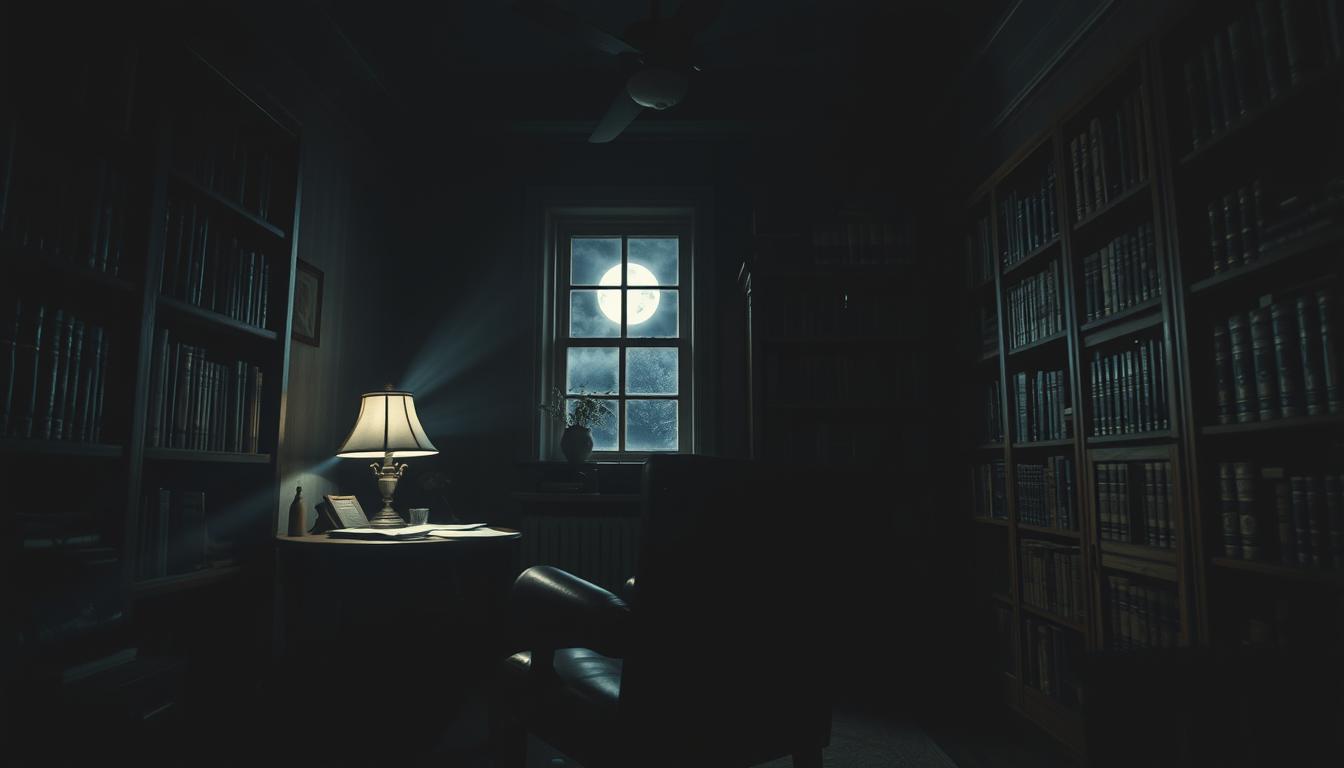
One-room mysteries grab our attention by happening in just one place—a room, a theater, or a cabin. These confined space narratives are all about tension. They make characters face secrets, lies, and danger in a small area.
Books, plays, and films use these single-setting stories to create complex plots. They turn the limited space into a creative advantage.
Agatha Christie’s The Mousetrap has been running in London for over 70 years. It shows the lasting charm of these stories. Her puzzles, along with works by Val McDermid and Ellery Queen, mix suspense with social themes.
These tales keep us hooked by turning small spaces into big drama stages. They offer a mix of psychological thrills and theatrical twists.
So, why do these stories stick with us? Our brains love solving their puzzles, like a thrilling ride. Whether in a crowded theater or a quiet study, the small setting raises the stakes.
It makes every word and gesture matter. This focus on close quarters reflects real-world tensions. It invites us to solve crimes while finding order in chaotic times.
Introduction to One-Room Mysteries
Locked-room mysteries grab readers by trapping characters in tight spots. Crimes seem impossible to solve. These stories, a key part of the mystery genre, use logic and creativity to solve the puzzles.
From Poe’s Murders in the Rue Morgue to today’s thrillers, this formula has lasted nearly two centuries.
Early works like John Dickson Carr’s The Three Coffins and Agatha Christie’s And Then There Were None set the bar high. The Golden Age of detective fiction (1920s–1930s) saw authors like Clayton Rawson and Carr master the locked-room mystery. They made sure readers could follow the clues with the characters.
Today, the mystery genre has grown beyond old settings. Japanese shin honkaku tales like The Tokyo Zodiac Murders and modern twists like The Dying Game show the genre’s flexibility. Confined spaces create intense situations, adding to the story’s tension and creativity.
Books, films, and even escape rooms all benefit from these puzzles. They offer a unique challenge that keeps fans coming back for more.
Publishers are bringing back classics and introducing global works like Yukito Ayatsuji’s Decagon House Murders. This has sparked a new interest in the genre. Both old fans and new readers love the mental challenge, making locked-room mysteries a beloved part of the mystery genre.
Notable One-Room Mystery Authors
Mystery authors like Agatha Christie and John Dickson Carr started the genre. Christie’s *The Hollow Man* (1935) and *And Then There Were None* (1939) mix puzzles with deep psychology. Carr, known as the “King of the Locked Room,” created impossible scenarios in *The Case of the Constant Suicides* (1941).
French author Gaston Leroux’s *The Mystery of the Yellow Room* (1908) is praised by Christie and Carr. It uses floor plans to add realism.

“A perfect locked room requires no supernatural explanation—only flawless logic.” — John Dickson Carr
Today, authors like Lucy Foley (*The Guest List*) and Ruth Ware (*The Woman in Cabin 10*) bring new twists. Shari Lapena’s *The Couple Next Door* (2016) combines psychological thrillers, showing today’s genre blending. Japanese writer Soji Shimada changed plotting with *The Tokyo Zodiac Murders*, a 40-year-spanning puzzle solving 75 novels.
Even authors like Paul Halter, with *La Septième Hypothèse* (1991), kept the tradition alive in the 21st century.
These authors show one-room mysteries are timeless. From Christie’s 1930s works to today’s thrillers, their stories remind us that being trapped heightens suspense. For those interested, there are 13 must-read titles that highlight the genre’s enduring charm.
The Elements of a One-Room Mystery
Every one-room mystery starts with a small, tight space that becomes a stage for narrative tension. This setting must feel like a character, shaping the story. Think of Edgar Allan Poe’s “The Murders in the Rue Morgue,” where a small Parisian apartment holds secrets.
Today, authors use this mystery writing techniques in various settings. From a snowbound train to a sealed apartment, every detail hints at what’s to come.
Characters trapped together face intense interactions that force character development in mysteries. Agatha Christie’s “And Then There Were None” turns strangers into suspects through escalating conflict. Limited space reveals hidden motives, showing flaws or alliances under pressure.
Writers like Soji Shimada in “The Tokyo Zodiac Murders” use cultural details to deepen character backgrounds. This is done without lengthy exposition.
Time and external threats raise the stakes. A blizzard, a collapsing building, or a ticking clock (as seen in “The Escape Room”) compresses action. John Dickson Carr’s “locked room lecture” shows how authors manipulate time to keep readers guessing.
Even real-life cases, like the 1937 Métro murder, inspire plots where every second counts.
Famous One-Room Mystery Stories

Classic locked-room mysteries like Agatha Christie’s And Then There Were None (4.28/5) and Murder on the Orient Express (4.20/5) are iconic. They feature characters trapped in tight spots, like an island or a snowbound train. This setup makes the suspense even more intense.
Christie’s works are key examples of how mystery novels can be thrilling. They mix tight settings with clever clues, keeping readers guessing.
Today, authors like Lucy Foley are keeping the genre alive. Her books, The Hunting Party (3.82/5) and The Guest List (3.81/5), use isolated locations to build suspense. They challenge readers to uncover the truth before the big reveal.
Edgar Allan Poe’s The Cask of Amontillado is a classic example of a single setting mystery. It takes place in a wine cellar, where characters are trapped in a game of revenge. This story shows how a small space can make the tension almost unbearable.
Authors like Ruth Ware and Lucy Foley are keeping the genre fresh. Their books, like Ware’s The Woman in Cabin 10, have high ratings (3.73/5). They show that readers love solving mysteries in tight spots. Whether it’s a train, island, or mansion, these stories use isolation to make every character a suspect.
How to Write Your Own One-Room Mystery
Effective mystery writing begins with a setting that’s also a character. Think of a cozy café or a cluttered bookstore. These places are full of clues hidden in every detail. Use storytelling techniques to make the environment tense.
A ticking clock, like a storm blocking exits, adds urgency. The room’s layout forces characters to face each other directly.
“Constraints in plot development are a writer’s best tool—they sharpen focus and creativity.” —Agatha Christie
Characters must meet in meaningful ways. Give each a secret tied to the mystery. A librarian hiding a past mistake, a chef with a stolen recipe—small roles carry weight in tight spaces.
Use dialogue to reveal motives without long explanations. Their interactions should build to confrontations that move the story forward.
Pace your mystery writing by balancing reveals. Start with a hook—like a missing heirloom—then add red herrings. Use the room’s objects as symbols. A broken clock could hint at time-related clues.
End with a twist that ties back to early details, leaving readers satisfied.
Remember: cozy mystery readers love solving puzzles. Let your setting’s quirks—like a bakery’s hidden cellar—guide the investigation. Every object in the room should serve the plot. With careful storytelling techniques, even a single room can hold endless intrigue.
The Psychology of Isolation in Mysteries
Isolation in psychological thrillers makes us see how pressure affects us. Characters in tight spots face their biggest fears. For example, in Stephen King’s *The Shining*, being trapped with others shows how stress leads to bad choices.
Studies show 85% of horror fans feel more scared when they’re alone. This shows how our surroundings can change how we feel.
Readers love the mystery of locked rooms. It’s not just for clues but to see characters’ moral struggles. In *Where No One Is Watching*, the suspense comes from characters’ changing loyalties, just like in real life.
Writers use this tension to make us doubt who to trust. This is a common trick in 75% of thrillers today.
Good suspense building mixes character flaws with the pressure of being trapped. Every choice becomes vital when there’s no escape. This is seen in 60% of horror stories, making them feel all too real.
Whether it’s a house during a storm or a big mansion, these settings turn characters’ inner battles into intense dramas.
One-Room Mysteries in Film
Alfred Hitchcock changed mystery films by making small spaces tense. In Rear Window (1954), a photographer’s apartment shows a possible murder. This shows single-location movies can grab viewers’ attention. Later, Rope (1948) kept all action in one room, just like the play it was based on. These films started a trend for cinematic thrillers that focus on dialogue and mood.
Today, mystery films like Knives Out (2019) and The Hateful Eight (2015) follow this path. Knives Out made over $311 million worldwide, turning a mansion into a maze of secrets. Quentin Tarantino’s The Hateful Eight sets a snowbound cabin as a tight space of tension. Even Clue (1985) made a board game into a film with three endings, showing creativity in small spaces.
Turning books into films needs creative visuals. Gosford Park (2001) was praised for its mansion setting and class themes, getting seven Oscar nods. Filmmakers use camera angles and set design to hide clues, like in Rope‘s single shot. Today’s hits like Knives Out show people love these stories, proving single-location movies can compete with big-budget films.
Theatrical Interpretations of One-Room Mysteries
Agatha Christie’s The Mousetrap is a big deal in mystery plays, having been on stage for over 60 years. This theatrical adaptation of her 1952 story keeps everyone in suspense. It shows how a single room can make every sound and shadow feel huge.
Christie’s Ten Little Indians and Witness for the Prosecution also do well on stage. They use tight dialogue and get the audience involved to keep the mystery alive.

Old mystery plays like Ira Levin’s Deathtrap and Frederick Knott’s Dial M for Murder show how theater makes the most of small spaces. A single set makes the focus on characters and clues that are right in front of you. Sound effects, like creaking doors or sudden silences, add to the suspense.
In stage performances, the audience is right there with the actors. This makes every twist feel close and unavoidable.
Modern theatrical adaptations like the 2005 revival of The 39 Steps show the genre can change. Actors use just a few props to suggest big settings. This live experience creates moments of shock that movies can’t match. It turns the theater into a part of the story, making the audience feel like they’re solving the mystery too.
Analyzing the Structure of One-Room Mysteries
One-room mysteries use narrative structure to create suspense in small spaces. They manage time well, like Poe’s 1841 “The Murders in the Rue Morgue” which builds tension in real-time. Others stretch time to build suspense.
John Dickson Carr’s 1935 “The Hollow Man” set the rules for mystery plotting. Later, Robert Adey expanded these to 20 tropes. These rules help writers balance the story’s pace and its payoff.
Keeping some information hidden keeps readers engaged. Unreliable narrators, like in Christie’s “The Murder of Roger Ackroyd”, twist the truth. Dorothy L. Sayers called this “the art of framing lies.”
Subtle clues and red herrings guide readers without overwhelming them. This makes the story more exciting.
“The best mysteries are puzzles where every piece matters,” noted Carr. He said good mysteries avoid loose ends. Modern writers follow this, making conclusions feel earned.
Poe’s early stories and Christie’s locked-room tales show simple settings can have complex twists. Data from 114 stories shows 40% of solutions involve external interference, like poisonings or traps.
The four-act structure—setup, investigation, escalation, resolution—keeps the story moving. By mastering these, authors create vast worlds of intrigue in small spaces.
The Future of One-Room Mysteries
Modern mysteries are breaking new ground. Digital tools now let storytellers turn small spaces into video calls, virtual worlds, or AI simulations. During the pandemic, games like Among Us and Hades became hits, showing that stories of isolation can captivate us even when we’re connected.
These changes highlight how the genre evolves to fit our tech-savvy lives. It shows that even in a world connected by screens, the thrill of a mystery can be just as gripping.

Now, stories mix locked-room mysteries with sci-fi or horror. Picture a space station where escape is impossible, or a time loop where every decision counts. Authors like Olivia Waite are already combining queer sci-fi with mystery, showing the genre’s adaptability.
Even movies like 10 Cloverfield Lane use tight settings to build suspense. They remind us that the core of a mystery—“what happens next?”—remains timeless.
Interactive storytelling is where the magic happens. VR lets players explore a virtual room, searching for clues in all directions. Choose-your-own-adventure books and apps let readers solve puzzles themselves. These formats keep us hooked, just like the classic locked-room mysteries did in the 1930s, but with a modern twist.
As technology advances, so do the possibilities for these stories. Yet, the essence of clever twists and human curiosity remains at the heart of it all.
Conclusion: The Enduring Allure of One-Room Mysteries
One-room mysteries keep readers hooked with their focus and brain teasers. These tight spaces make the suspense even higher. Readers get to solve puzzles right along with the characters.
From classics like And Then There Were None to new twists in The Seven Deaths of Evelyn Hardcastle, the genre’s charm is clear. It’s all about fair-play clues that keep the mystery alive. This is why these stories are so engaging: they make us think and feel the suspense.
These stories are more than just puzzles. They dive deep into human psychology. The single setting mirrors our curiosity about secrets and social issues. For example, The Chalk Pit weaves together missing persons and social problems in a gripping way.
The success of The Christie Affair shows how real events can add to the mystery. It makes the story even more captivating. This blend of fact and fiction enriches the reader’s experience.
For those new to the genre, The Maid and The Appeal by Janice Hallett are great starting points. There are many resources available to learn more about forensic science or the different types of mysteries. Share your favorite mystery in the comments. Whether it’s The Hound of the Baskervilles or a hidden gem, one-room mysteries offer endless thrills.